
Contents:
- How Botty Strategies Work and Why Botty Reviews Ask About Them
- Conservative Botty Strategies: Spot Without Leverage
- Balanced Botty Strategies: Futures With a Wider Grid
- Aggressive Botty Strategies: Futures With a Tighter Grid
- Comparing Botty Strategies: Conservative vs Balanced vs Aggressive
- Botty vs a Classic Grid Bot: What Is Different
- What You See Before Launching a Botty Template
- Risks of Botty Strategies
- Frequently Asked Questions
- What strategies does Botty offer?
- What returns do Botty strategies show?
- Which Botty strategy is the safest?
- Can Botty liquidate a position?
- How is a Botty strategy different from a grid bot?
In short: Botty’s catalog has nine ready-made strategies: three each for BTC, ETH and SOL. Conservative strategies run on spot without leverage; Balanced and Aggressive run on futures. The historical average annual figures shown for these templates in the September 2026 investor presentation range from approximately 8% to 58%. They are calculations on historical data, not a forecast or a guarantee: results depend on the asset, strategy category, parameters and testing period.
How Botty Strategies Work and Why Botty Reviews Ask About Them
People who search “Botty reviews” or “Botty strategies” usually want to know what the bot does and how its templates behaved in the past. The Botty trading bot does not guess market direction. It works with volatility through an averaging model: it splits capital into levels, buys more as price falls with growing order sizes, and closes the whole position once price returns above the average by a set step. Then the cycle restarts from the current price.
The order grid is calculated separately for each asset: number of orders, sizes and spacing are tuned to how BTC, ETH and SOL move, and built on at least five years of market history. This is what sets Botty strategies apart from a classic grid bot with equal spacing and equal order sizes.
Conservative Botty Strategies: Spot Without Leverage
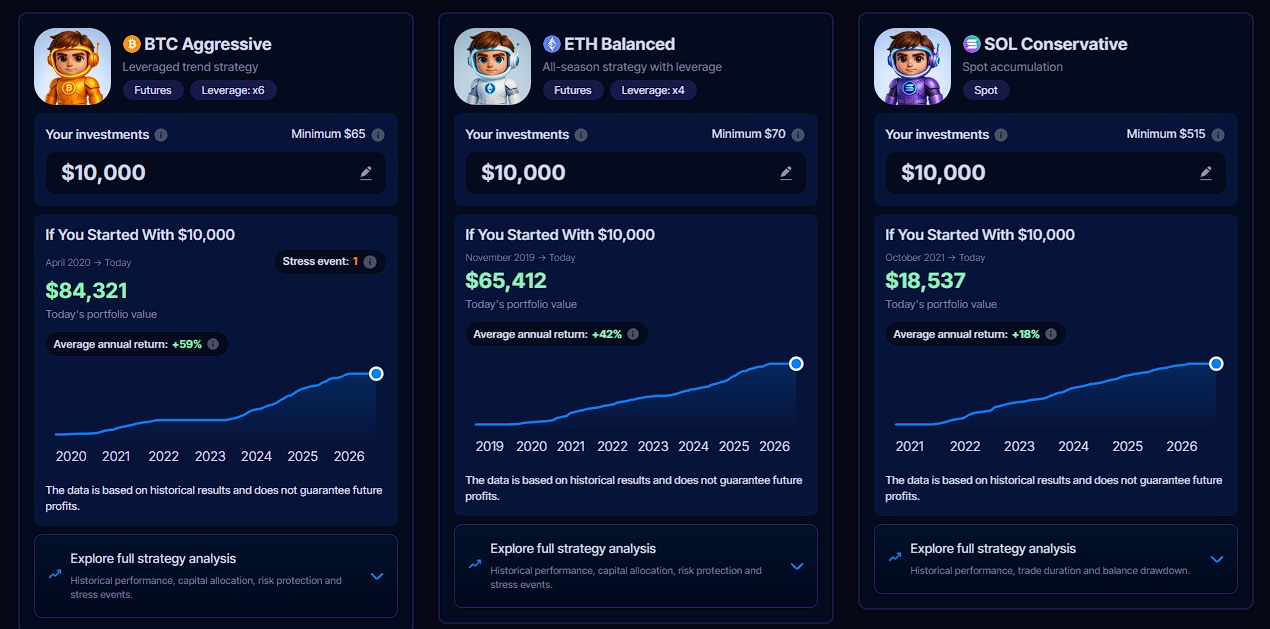
The Conservative strategy is spot. You buy the real asset into your own account and there is no liquidation: if price falls below the grid, the asset stays with you until sold, and no loss is realized. Trades are less frequent and potential is lower.
Balanced Botty Strategies: Futures With a Wider Grid
The Balanced strategy runs on futures with leverage and a wider grid. It trades less often than Aggressive and handles deep drawdowns better.
Aggressive Botty Strategies: Futures With a Tighter Grid
The Aggressive strategy uses a tighter grid: more trades and higher potential, but also higher sensitivity to sharp market moves.
All figures come from Botty’s September 2026 investor presentation, calculated on historical data beginning between 2018 and 2023 and continuing through 2026, and are not independently verified. For example, the cumulative historical result shown for Balanced ETH is +269.4%, and for Conservative BTC +40.3%; these figures also describe the past, not the future.
Comparing Botty Strategies: Conservative vs Balanced vs Aggressive
Botty vs a Classic Grid Bot: What Is Different
What You See Before Launching a Botty Template
results for every year and month across the full data period;
the maximum historical drawdown;
the shortest, average and longest time in a trade;
headroom: how far price can fall before the lowest grid level;
the grid itself: at which levels and in what size the system will add.
The current public version does not include a feature for running your own calculations with arbitrary settings. What is shown is pre-calculated historical data for the ready-made templates.
Risks of Botty Strategies
Historical figures do not guarantee future results. Results depend on the market: more movement means more cycles, less movement means fewer. An open position can sit in drawdown for days or weeks. Futures strategies use leverage, so liquidation is possible if price falls without pullbacks; capital is split 50/50 between work and reserve by default, and a larger reserve pushes the liquidation price further away at the cost of lower potential. The Conservative spot strategy has no liquidation. Positive Botty user reviews describe individual experience and do not guarantee the same result for someone else.
Frequently Asked Questions
What strategies does Botty offer?
Three categories: Conservative (spot, no leverage), Balanced (futures, wider grid) and Aggressive (futures, tighter grid), for BTC, ETH and SOL: nine templates in total.
What returns do Botty strategies show?
Historical average annual figures for the ready-made templates range from approximately 8% to 58%, depending on asset and category. They are historical calculations, not a guarantee.
Which Botty strategy is the safest?
Conservative: spot with no leverage and no liquidation. This does not remove market risk or drawdowns.
Can Botty liquidate a position?
Liquidation is possible only in futures strategies (Balanced and Aggressive) if price falls without pullbacks. The risk depends on leverage and the share of capital in reserve.
How is a Botty strategy different from a grid bot?
Botty calculates spacing and order sizes for each asset and increases them as price falls, and it closes the whole position from the average price. A classic grid bot uses fixed spacing and size.
This article is for information only and is not investment advice. Past results do not guarantee future ones. Trading financial markets carries the risk of losing capital.